


Clifford+T logical compilation


Optimizing Quantum Circuits: Slashing T-Gate Costs with Magnitude Approximation and the Ising Model
The full article is available here: https://arxiv.org/abs/2605.09671
As we move closer to the era of fault-tolerant quantum computing, developers face a significant bottleneck: hardware constraints. Modern Quantum Error Correction (QEC) schemes require quantum computers to operate using a universal, but discrete, set of gates—most commonly, the Clifford+T gate set.
Because this set is discrete, we cannot natively implement just any arbitrary quantum operation (like a specific single-qubit rotation). Instead, we have to approximate these continuous rotations using a sequence of discrete gates. The efficiency of these approximations directly dictates how fast and accurately a quantum algorithm can run.
The most "expensive" gates in these sequences are the T-gates. Minimizing the T-gate count (or "T-count") is one of the most critical challenges in quantum circuit compilation today.
The Status Quo: The "Diagonal" Tax
Currently, the industry baseline for approximating single-qubit rotations is Diagonal Approximation.
Because a general single-qubit rotation isn't naturally "diagonal," compilers typically decompose it into a sequence of three simpler rotations—often using Euler angles, like an X-Z-X sequence. The compiler then approximates each of these three rotations individually.
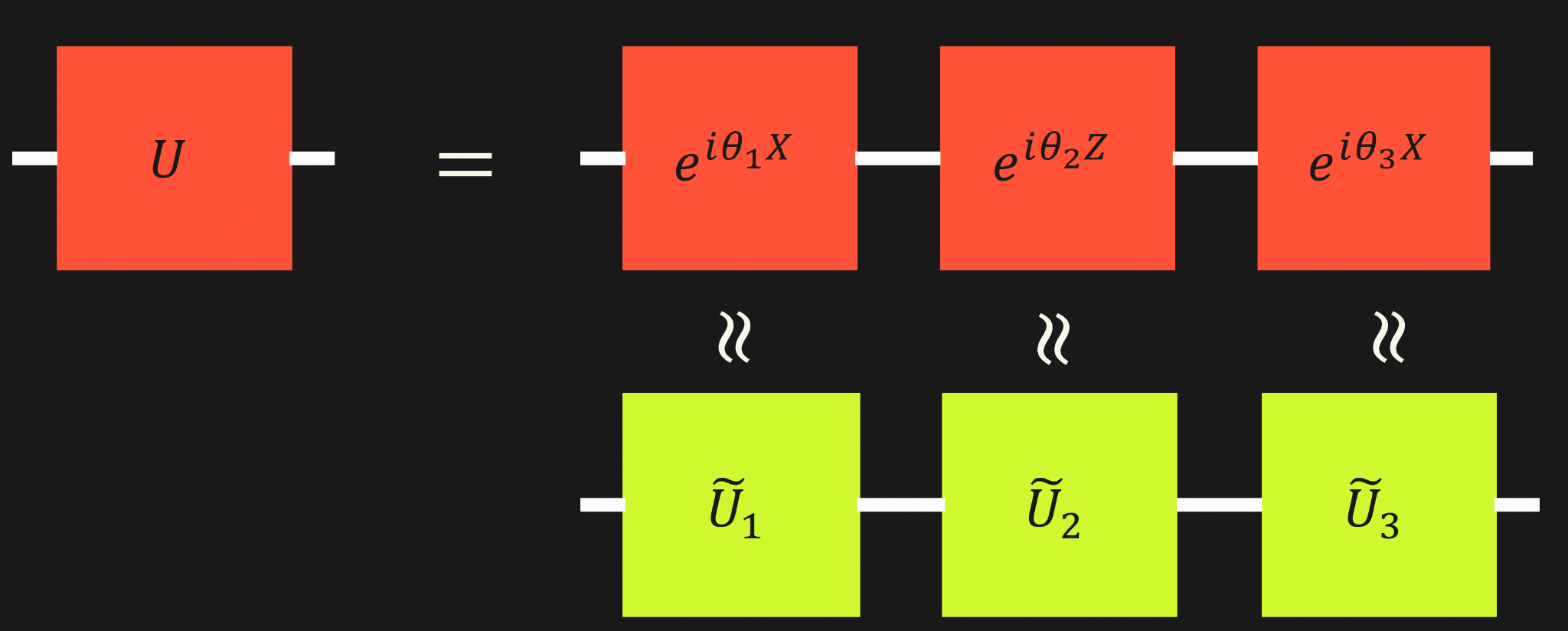
Here is the catch: approximating just one of these diagonal rotations to a target precision (ε) costs about 1 log₂(1/ε) T-gates. Because standard Diagonal Approximation forces us to synthesize all three rotations individually, the total cost triples to roughly 9 log₂(1/ε) for the whole unitary (or 3 log₂(1/ε) per rotation). This factor of 3 is a heavy "tax" on circuit depth.
A Powerful Tool: Magnitude Approximation
To bypass this overhead, we can utilize an existing technique called Magnitude Approximation (MA), recently formalized by researchers for the Clifford+T gate set (e.g., Kliuchnikov et al., 2023).
Instead of strictly approximating all three rotations in the X-Z-X sequence to high precision, MA focuses strictly on the central rotation (the Z). It achieves the desired precision for the central rotation while allowing for massive, arbitrary "residual errors" on the outer orthogonal axes (the X rotations).
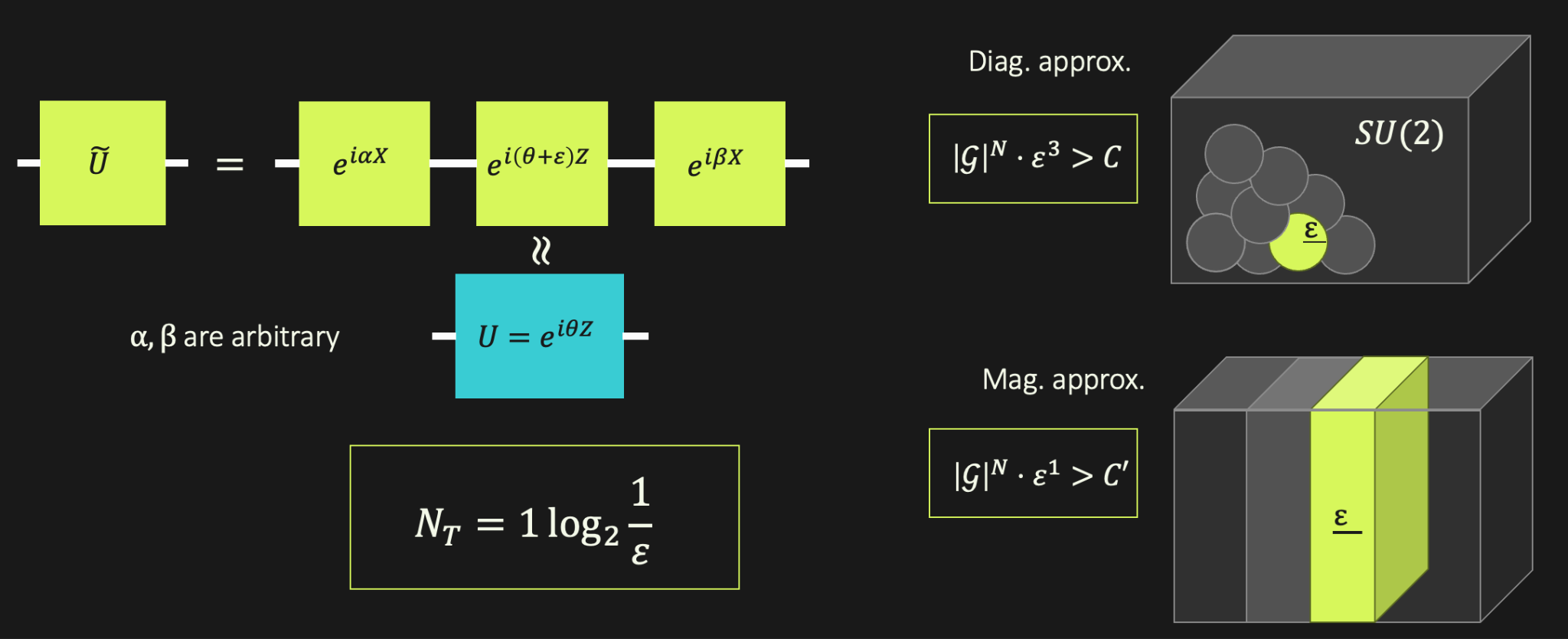
By relaxing the rules and allowing these arbitrary residual errors, MA drops the T-count of the approximated gate from 3 log₂(1/ε) down to just 1 log₂(1/ε). In a larger quantum circuit, these residuals can be mathematically "pushed" through the circuit. Because certain rotations commute with entangling gates like CNOTs, the residuals can "hop" across the circuit until they merge with existing rotations on the same axis or cancel out entirely.
Our Contribution: The Global Ising Model Challenge
While Magnitude Approximation is highly efficient for a single gate, our work solves the problem of how to apply it effectively across a large-scale quantum circuit.
You cannot just blindly apply MA to every gate. If a residual error gets "stuck" behind an entangling gate it cannot commute through, it becomes a new error that must be approximated all over again, defeating the purpose.
Deciding whether to use Magnitude Approximation (which creates traveling residuals) or Diagonal Approximation (which contains errors locally but costs 3x as much) for every single rotation in a circuit creates a massive combinatorial puzzle. For a circuit with N segments, there are 2^N possible configurations.
To solve this without exponential classical computing delays, we mapped the delegation problem to a concept from physics: the 1D Ising model.

By treating each circuit segment as a "spin" site (σ) in an Ising chain, we can assign a mathematical "energy" to the system.
- Applying MA acts as one spin state (+1).
- Applying Diagonal Approximation acts as the opposite spin state (-1).
- The "local field" (h) biases segments toward the cheaper MA method.
- The "interaction energy" (J) between neighboring spins penalizes the system if incompatible choices are made (e.g., creating a residual that the neighboring segment cannot absorb).
Using a dynamic programming algorithm, we can find the "ground state" (the lowest energy configuration) of this Ising model in linear time. This gives us the absolute mathematically optimal approximation strategy for the entire circuit instantly.
Real-World Results
To test this framework, we benchmarked the Ising model optimization against the standard all-diagonal baseline across various quantum circuits generated using the Classiq platform.
For randomized, unstructured quantum circuits, our global optimization strategy achieved an average T-gate reduction of 26%. However, the results are even more striking for structured algorithms used in practical applications, such as quantum chemistry.
For highly structured circuits like the UCCSD ansatz—a cornerstone algorithm for simulating molecules—the optimization achieved a massive 58% reduction in T-gates. This happens because structured circuits often have long, predictable chains of commuting gates, creating perfect "highways" for residual errors to travel and be absorbed safely.
結論
As we push the boundaries of what near-term and fault-tolerant quantum computers can do, intelligent circuit compilation is just as important as hardware improvements. By leveraging Magnitude Approximation to allow "temporary" errors within the circuit, and managing those errors globally using our 1D Ising model framework, we can drastically cut the resource overhead of quantum algorithms, bringing us one step closer to practical quantum advantage.
Optimizing Quantum Circuits: Slashing T-Gate Costs with Magnitude Approximation and the Ising Model
The full article is available here: https://arxiv.org/abs/2605.09671
As we move closer to the era of fault-tolerant quantum computing, developers face a significant bottleneck: hardware constraints. Modern Quantum Error Correction (QEC) schemes require quantum computers to operate using a universal, but discrete, set of gates—most commonly, the Clifford+T gate set.
Because this set is discrete, we cannot natively implement just any arbitrary quantum operation (like a specific single-qubit rotation). Instead, we have to approximate these continuous rotations using a sequence of discrete gates. The efficiency of these approximations directly dictates how fast and accurately a quantum algorithm can run.
The most "expensive" gates in these sequences are the T-gates. Minimizing the T-gate count (or "T-count") is one of the most critical challenges in quantum circuit compilation today.
The Status Quo: The "Diagonal" Tax
Currently, the industry baseline for approximating single-qubit rotations is Diagonal Approximation.
Because a general single-qubit rotation isn't naturally "diagonal," compilers typically decompose it into a sequence of three simpler rotations—often using Euler angles, like an X-Z-X sequence. The compiler then approximates each of these three rotations individually.
Here is the catch: approximating just one of these diagonal rotations to a target precision (ε) costs about 1 log₂(1/ε) T-gates. Because standard Diagonal Approximation forces us to synthesize all three rotations individually, the total cost triples to roughly 9 log₂(1/ε) for the whole unitary (or 3 log₂(1/ε) per rotation). This factor of 3 is a heavy "tax" on circuit depth.
A Powerful Tool: Magnitude Approximation
To bypass this overhead, we can utilize an existing technique called Magnitude Approximation (MA), recently formalized by researchers for the Clifford+T gate set (e.g., Kliuchnikov et al., 2023).
Instead of strictly approximating all three rotations in the X-Z-X sequence to high precision, MA focuses strictly on the central rotation (the Z). It achieves the desired precision for the central rotation while allowing for massive, arbitrary "residual errors" on the outer orthogonal axes (the X rotations).
By relaxing the rules and allowing these arbitrary residual errors, MA drops the T-count of the approximated gate from 3 log₂(1/ε) down to just 1 log₂(1/ε). In a larger quantum circuit, these residuals can be mathematically "pushed" through the circuit. Because certain rotations commute with entangling gates like CNOTs, the residuals can "hop" across the circuit until they merge with existing rotations on the same axis or cancel out entirely.
Our Contribution: The Global Ising Model Challenge
While Magnitude Approximation is highly efficient for a single gate, our work solves the problem of how to apply it effectively across a large-scale quantum circuit.
You cannot just blindly apply MA to every gate. If a residual error gets "stuck" behind an entangling gate it cannot commute through, it becomes a new error that must be approximated all over again, defeating the purpose.
Deciding whether to use Magnitude Approximation (which creates traveling residuals) or Diagonal Approximation (which contains errors locally but costs 3x as much) for every single rotation in a circuit creates a massive combinatorial puzzle. For a circuit with N segments, there are 2^N possible configurations.
To solve this without exponential classical computing delays, we mapped the delegation problem to a concept from physics: the 1D Ising model.
By treating each circuit segment as a "spin" site (σ) in an Ising chain, we can assign a mathematical "energy" to the system.
- Applying MA acts as one spin state (+1).
- Applying Diagonal Approximation acts as the opposite spin state (-1).
- The "local field" (h) biases segments toward the cheaper MA method.
- The "interaction energy" (J) between neighboring spins penalizes the system if incompatible choices are made (e.g., creating a residual that the neighboring segment cannot absorb).
Using a dynamic programming algorithm, we can find the "ground state" (the lowest energy configuration) of this Ising model in linear time. This gives us the absolute mathematically optimal approximation strategy for the entire circuit instantly.
Real-World Results
To test this framework, we benchmarked the Ising model optimization against the standard all-diagonal baseline across various quantum circuits generated using the Classiq platform.
For randomized, unstructured quantum circuits, our global optimization strategy achieved an average T-gate reduction of 26%. However, the results are even more striking for structured algorithms used in practical applications, such as quantum chemistry.
For highly structured circuits like the UCCSD ansatz—a cornerstone algorithm for simulating molecules—the optimization achieved a massive 58% reduction in T-gates. This happens because structured circuits often have long, predictable chains of commuting gates, creating perfect "highways" for residual errors to travel and be absorbed safely.
結論
As we push the boundaries of what near-term and fault-tolerant quantum computers can do, intelligent circuit compilation is just as important as hardware improvements. By leveraging Magnitude Approximation to allow "temporary" errors within the circuit, and managing those errors globally using our 1D Ising model framework, we can drastically cut the resource overhead of quantum algorithms, bringing us one step closer to practical quantum advantage.