


Wrapping up the Classiq Quantum Circuit Challenge


The Classiq Quantum Circuit Challenge concluded with results that exceeded our most optimistic expectations. Participants were asked to minimize the depth of a circuit implementing a specified quantum phase oracle. After internal benchmarking, we did not expect submissions with depth below 200. In the end, 25 participants submitted circuits below that threshold, and two reached a depth of 95. In this blog post, we announce the challenge winners and describe their solution approaches.
The challenge and its metrics
The task was to encode a rasterized 64×64 version of the Classiq logo as a quantum phase oracle. For each coordinate pair, the circuit had to apply a phase shift of π if the corresponding pixel belonged to the logo and no phase shift otherwise. It also had to preserve the coordinates and return all auxiliary qubits, or ancillas, to zero. This compute–phase–uncompute pattern allows the oracle to act coherently on a superposition of coordinates.
A logo offers a playful setting for a widely used computational task: evaluating a Boolean condition and encoding its answer in a quantum phase. Such oracles are central to Grover search and amplitude amplification. The cost of implementing them can substantially affect the resources required by the larger algorithm.
The primary score was circuit depth in the U3/CX gate basis, consisting of U3 single-qubit gates and controlled-X (CX) gates. For scoring purposes, each gate occupied one time step, and all-to-all connectivity was assumed. Gates acting on disjoint qubits could occupy the same layer. CX count broke ties, and the width limit was 18 qubits: 12 coordinate qubits and at most six ancillas. Our intentionally simple, unoptimized baseline had depth 5,329 and 3,502 CX gates, providing a transparent starting point for participants.
An international community of participants
The challenge ran from August 28 to September 30 and attracted 387 registered participants from 40 countries. Participants synthesized 6,091 unique circuits, and 101 people submitted valid solutions. We were especially pleased by the sustained engagement and the diversity of approaches. The five countries with the most participants were India, the United States, Israel, Canada, and the United Kingdom.
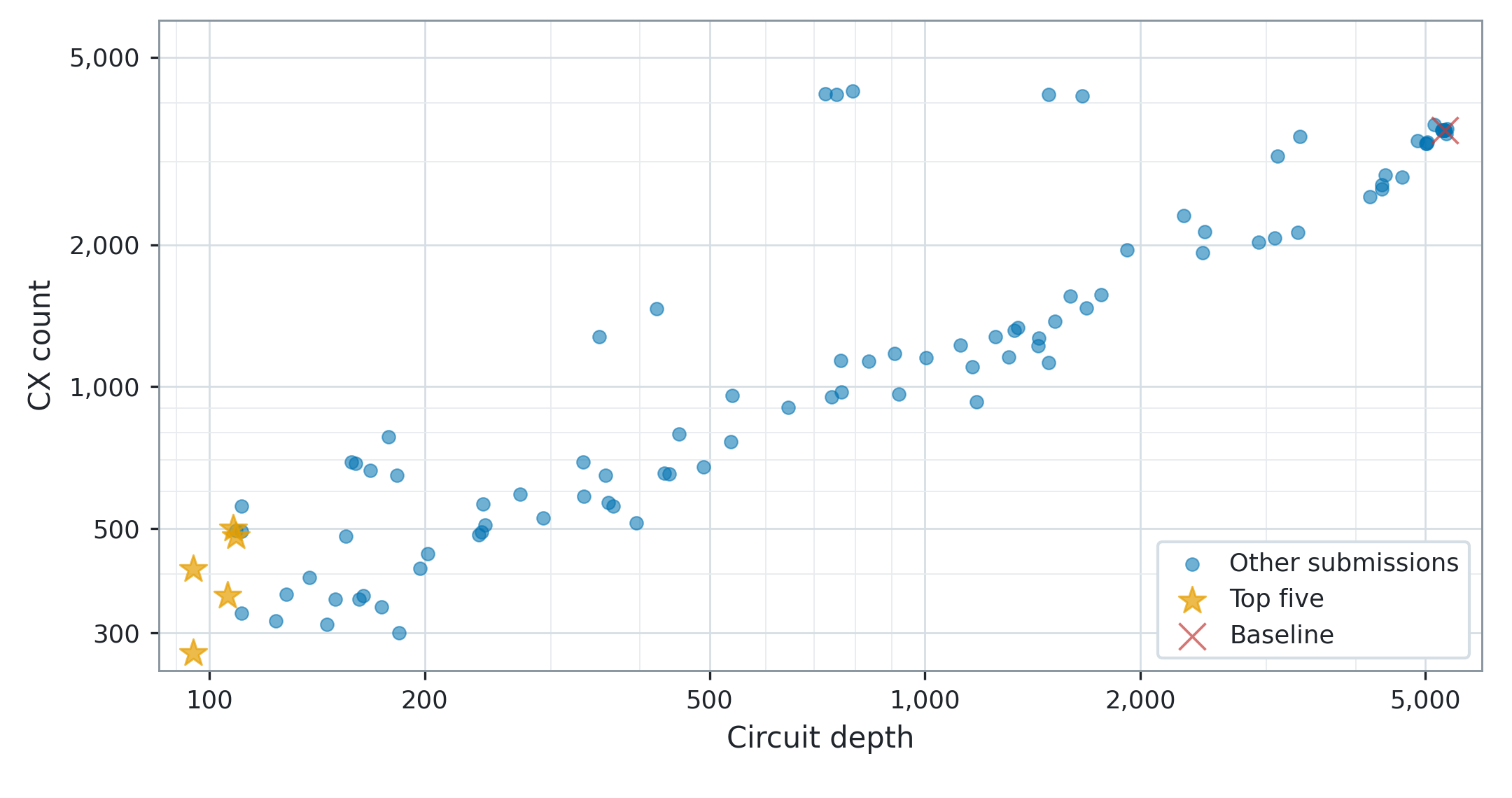
Efficient circuit synthesis is central to Classiq’s work, making this a natural focus for the competition. Participants had free access to the Classiq platform throughout the challenge. Figure 1 shows the extent of their progress: the best depth of 95 represents approximately a 56-fold reduction in depth relative to our deliberately unoptimized baseline. Understanding how participants achieved these improvements is as valuable as the scores themselves.
Compressing the logo before synthesizing the circuit
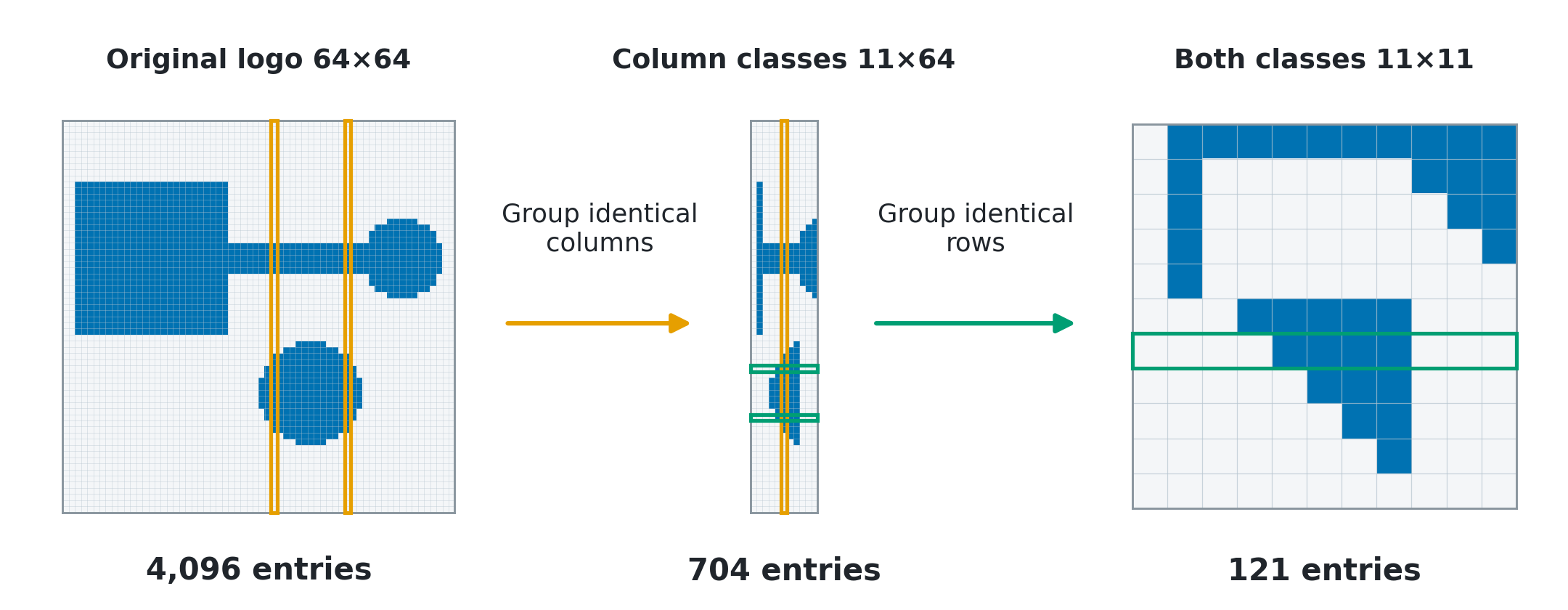
Many solutions began by reducing the information needed to decide whether a pixel belongs to the logo. The target image contains 4,096 pixels but only 11 distinct column patterns and 11 distinct row patterns. As Figure 2 illustrates, grouping identical columns reduces the table from 64×64 to 11×64 entries; grouping identical rows reduces it further to 11×11. With the two coordinate-to-class mappings, the smaller table reproduces every pixel exactly.
A reversible implementation computes suitable labels, applies the phase associated with their combination, and uncomputes the labels. Two winners, Andrei and Sourabh, explicitly used this repeated-pattern observation; Daksh developed a related joint encoding. Their optimized encodings retain different distinctions because the most compact classical label is not necessarily the cheapest one to compute reversibly. The reduction in table size therefore does not translate directly into an equivalent reduction in gate count or depth.
The five winning solutions
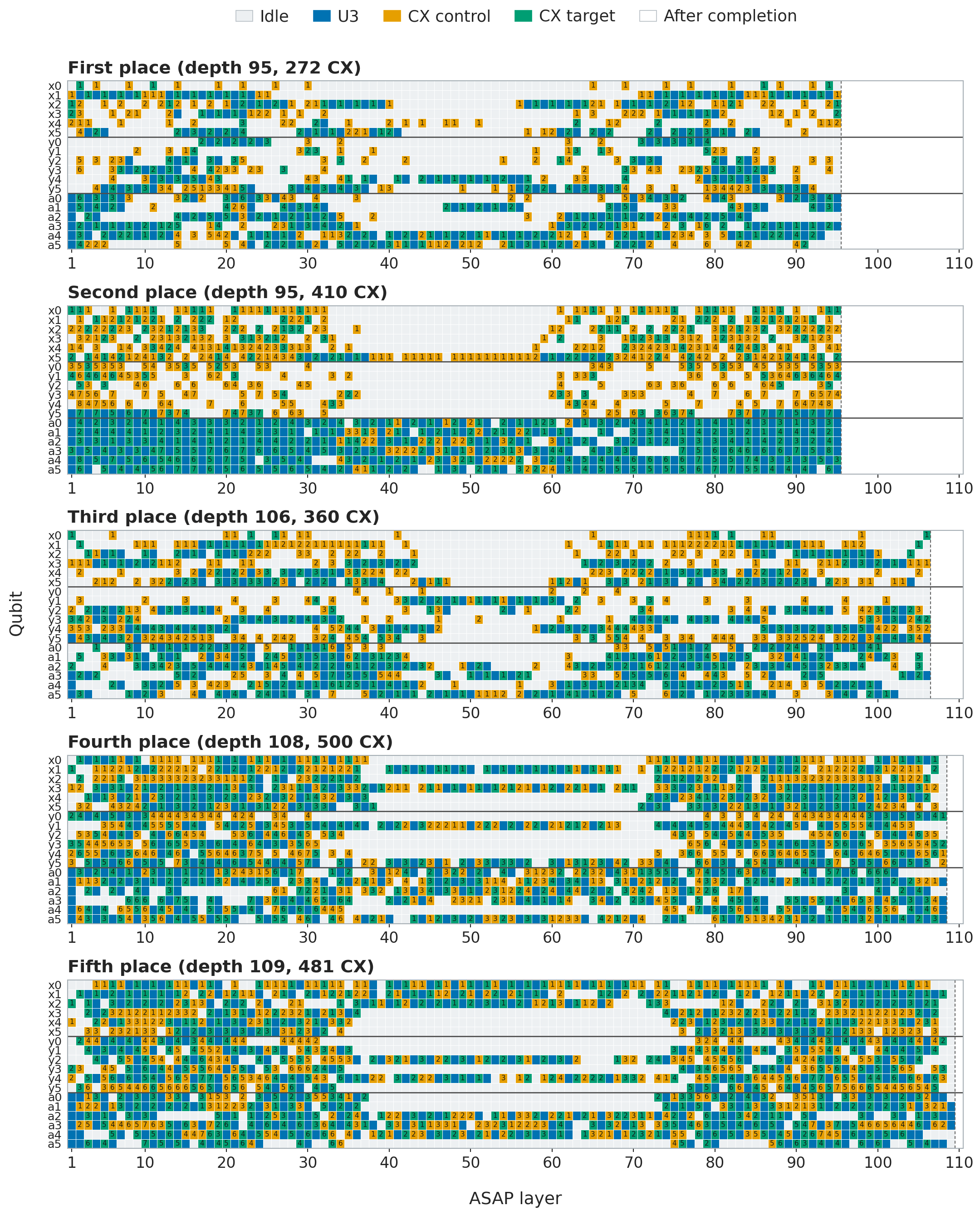
Congratulations to PoJen Wang, Daksh Shami, Jayachandiran U, Andrei Diaconu, and Sourabh Nirvani on their outstanding results! Each will receive a $2,000 prize from Classiq. The profiles below summarize their principal ideas, and Figure 3 compares their circuits on a common scale.
First place (PoJen Wang, USA)
PoJen recasts the geometry as comparisons between compact row-distance and column-radius codes, with additional flags handling the square and bar. The key freedom is that the codes need only preserve the required comparisons: they do not have to equal literal geometric distances. His approach searches over these valid encodings and small reversible circuits, allowing the row and column calculations to run largely in parallel. His final circuit achieves depth 95 with 272 CX gates, the lowest CX count on the leaderboard.
Second place (Daksh Shami, USA)
Daksh encodes the phase decision using seven bits: three features of the column, three of the row, and one shared bit combining information from both. This avoids two separate four-bit labels. Only 120 of the 128 possible addresses occur, leaving some freedom in how the eight unused addresses are treated. A network of CX gates and phase rotations implements the lookup, followed by restoration of the inputs and ancillas. The circuit matches the first-place depth of 95 with 410 CX gates.
Third place (Jayachandiran U, India)
Jayachandiran expresses the square, bar, and both circles through one compact comparison. The row selects a vertical band and is reversibly recoded into a periodic, tent-shaped distance value; the column supplies an encoded half-height and a validity flag. The carry from a four-bit addition then determines whether to apply the phase, subject to that flag. This shared arithmetic structure, refined through scheduling and local rewrites, yields depth 106 with 360 CX gates.
Fourth place (Andrei Diaconu, Romania)
Andrei uses quantum interference to convert phase patterns into Boolean labels and organizes the label encoders as a cascade. Earlier labels become inputs to later encoders, reducing their cost. A central phase polynomial, a weighted sum of bit parities, combines the encoded information, while the surrounding operations supply the remaining phase corrections and restore the workspace. The documented interface has 195 reachable code pairs. This coordinated design of the encoding and phase calculation reaches depth 108 with 500 CX gates.
Fifth place (Sourabh Nirvani, India)
Sourabh combines coordinate-class compression with detailed scheduling optimization. His eight-bit lookup has 182 reachable code combinations out of 256, allowing the phases assigned to unused combinations to be chosen to simplify the implementation. Encoding, lookup, and uncomputation overlap as individual wires become available. Local resynthesis shortens congested regions, and simplifications exploit the known initial states of ancillas. The final circuit reaches depth 109 with 481 CX gates, illustrating the value of optimizing the interfaces between stages.
Strong results throughout the leaderboard
The creativity evident in the winning circuits was also apparent well beyond the top five. The sixth-place solution matched Sourabh’s depth of 109 with just 13 more CX gates. The tenth-place solution achieved depth 124 with 318 CX gates while using a Clifford+T representation up to a global phase. This gate set is widely used in fault-tolerant quantum computing, giving the solution an additional point of interest beyond its competition score.
All five winning submissions passed exhaustive numerical verification for all 4,096 coordinate-basis inputs. The checks included coordinate preservation, ancilla cleanup, and the required phase pattern, up to a single global phase. This is essential for a phase oracle: reproducing the correct Boolean pixel values alone would not establish the required coherent quantum action.
Lessons for quantum circuit optimization
Across these different constructions, a common lesson emerges: the representation of a problem and the implementation of its circuit should be optimized together. Participants exploited geometry or repeated patterns to simplify the Boolean function, chose encodings that were inexpensive to compute reversibly, and refined the schedules of the resulting operations. Unreachable combinations of internal labels provided additional freedom, since their phases could be chosen to simplify the circuit without changing its action on valid inputs.
The results also demonstrate that depth and gate count are distinct objectives. PoJen and Daksh both achieved depth 95 with different CX counts, while several deeper circuits used fewer CX gates than some of the winning entries. Finding a good balance required extensive experimentation: the winners described searches over encodings and phase representations, automated circuit rewrites, and repeated verification.
AI tools also played a significant role in this iterative process. Many participants used these tools for mathematical exploration, implementation, and refinement, highlighting AI’s growing role in quantum-computing workflows. At Classiq, we recognized this potential early and have deeply integrated AI into our platform and documentation. We continue to improve these capabilities to help users move more effectively from understanding a quantum algorithm to implementing it efficiently and evaluating its performance.
Future challenges
Thank you to everyone who participated, and congratulations again to the five winners! We will organize similar competitions in the future, building on the quality of the work and the community’s engagement. Strong submissions give us confidence that participants can contribute meaningful solutions to demanding quantum computing problems. For the next challenge, we are therefore considering a more application-focused problem, perhaps even one at research-level difficulty. We look forward to seeing what this community develops next.
The Classiq Quantum Circuit Challenge concluded with results that exceeded our most optimistic expectations. Participants were asked to minimize the depth of a circuit implementing a specified quantum phase oracle. After internal benchmarking, we did not expect submissions with depth below 200. In the end, 25 participants submitted circuits below that threshold, and two reached a depth of 95. In this blog post, we announce the challenge winners and describe their solution approaches.
The challenge and its metrics
The task was to encode a rasterized 64×64 version of the Classiq logo as a quantum phase oracle. For each coordinate pair, the circuit had to apply a phase shift of π if the corresponding pixel belonged to the logo and no phase shift otherwise. It also had to preserve the coordinates and return all auxiliary qubits, or ancillas, to zero. This compute–phase–uncompute pattern allows the oracle to act coherently on a superposition of coordinates.
A logo offers a playful setting for a widely used computational task: evaluating a Boolean condition and encoding its answer in a quantum phase. Such oracles are central to Grover search and amplitude amplification. The cost of implementing them can substantially affect the resources required by the larger algorithm.
The primary score was circuit depth in the U3/CX gate basis, consisting of U3 single-qubit gates and controlled-X (CX) gates. For scoring purposes, each gate occupied one time step, and all-to-all connectivity was assumed. Gates acting on disjoint qubits could occupy the same layer. CX count broke ties, and the width limit was 18 qubits: 12 coordinate qubits and at most six ancillas. Our intentionally simple, unoptimized baseline had depth 5,329 and 3,502 CX gates, providing a transparent starting point for participants.
An international community of participants
The challenge ran from August 28 to September 30 and attracted 387 registered participants from 40 countries. Participants synthesized 6,091 unique circuits, and 101 people submitted valid solutions. We were especially pleased by the sustained engagement and the diversity of approaches. The five countries with the most participants were India, the United States, Israel, Canada, and the United Kingdom.
Efficient circuit synthesis is central to Classiq’s work, making this a natural focus for the competition. Participants had free access to the Classiq platform throughout the challenge. Figure 1 shows the extent of their progress: the best depth of 95 represents approximately a 56-fold reduction in depth relative to our deliberately unoptimized baseline. Understanding how participants achieved these improvements is as valuable as the scores themselves.
Compressing the logo before synthesizing the circuit
Many solutions began by reducing the information needed to decide whether a pixel belongs to the logo. The target image contains 4,096 pixels but only 11 distinct column patterns and 11 distinct row patterns. As Figure 2 illustrates, grouping identical columns reduces the table from 64×64 to 11×64 entries; grouping identical rows reduces it further to 11×11. With the two coordinate-to-class mappings, the smaller table reproduces every pixel exactly.
A reversible implementation computes suitable labels, applies the phase associated with their combination, and uncomputes the labels. Two winners, Andrei and Sourabh, explicitly used this repeated-pattern observation; Daksh developed a related joint encoding. Their optimized encodings retain different distinctions because the most compact classical label is not necessarily the cheapest one to compute reversibly. The reduction in table size therefore does not translate directly into an equivalent reduction in gate count or depth.
The five winning solutions
Congratulations to PoJen Wang, Daksh Shami, Jayachandiran U, Andrei Diaconu, and Sourabh Nirvani on their outstanding results! Each will receive a $2,000 prize from Classiq. The profiles below summarize their principal ideas, and Figure 3 compares their circuits on a common scale.
First place (PoJen Wang, USA)
PoJen recasts the geometry as comparisons between compact row-distance and column-radius codes, with additional flags handling the square and bar. The key freedom is that the codes need only preserve the required comparisons: they do not have to equal literal geometric distances. His approach searches over these valid encodings and small reversible circuits, allowing the row and column calculations to run largely in parallel. His final circuit achieves depth 95 with 272 CX gates, the lowest CX count on the leaderboard.
Second place (Daksh Shami, USA)
Daksh encodes the phase decision using seven bits: three features of the column, three of the row, and one shared bit combining information from both. This avoids two separate four-bit labels. Only 120 of the 128 possible addresses occur, leaving some freedom in how the eight unused addresses are treated. A network of CX gates and phase rotations implements the lookup, followed by restoration of the inputs and ancillas. The circuit matches the first-place depth of 95 with 410 CX gates.
Third place (Jayachandiran U, India)
Jayachandiran expresses the square, bar, and both circles through one compact comparison. The row selects a vertical band and is reversibly recoded into a periodic, tent-shaped distance value; the column supplies an encoded half-height and a validity flag. The carry from a four-bit addition then determines whether to apply the phase, subject to that flag. This shared arithmetic structure, refined through scheduling and local rewrites, yields depth 106 with 360 CX gates.
Fourth place (Andrei Diaconu, Romania)
Andrei uses quantum interference to convert phase patterns into Boolean labels and organizes the label encoders as a cascade. Earlier labels become inputs to later encoders, reducing their cost. A central phase polynomial, a weighted sum of bit parities, combines the encoded information, while the surrounding operations supply the remaining phase corrections and restore the workspace. The documented interface has 195 reachable code pairs. This coordinated design of the encoding and phase calculation reaches depth 108 with 500 CX gates.
Fifth place (Sourabh Nirvani, India)
Sourabh combines coordinate-class compression with detailed scheduling optimization. His eight-bit lookup has 182 reachable code combinations out of 256, allowing the phases assigned to unused combinations to be chosen to simplify the implementation. Encoding, lookup, and uncomputation overlap as individual wires become available. Local resynthesis shortens congested regions, and simplifications exploit the known initial states of ancillas. The final circuit reaches depth 109 with 481 CX gates, illustrating the value of optimizing the interfaces between stages.
Strong results throughout the leaderboard
The creativity evident in the winning circuits was also apparent well beyond the top five. The sixth-place solution matched Sourabh’s depth of 109 with just 13 more CX gates. The tenth-place solution achieved depth 124 with 318 CX gates while using a Clifford+T representation up to a global phase. This gate set is widely used in fault-tolerant quantum computing, giving the solution an additional point of interest beyond its competition score.
All five winning submissions passed exhaustive numerical verification for all 4,096 coordinate-basis inputs. The checks included coordinate preservation, ancilla cleanup, and the required phase pattern, up to a single global phase. This is essential for a phase oracle: reproducing the correct Boolean pixel values alone would not establish the required coherent quantum action.
Lessons for quantum circuit optimization
Across these different constructions, a common lesson emerges: the representation of a problem and the implementation of its circuit should be optimized together. Participants exploited geometry or repeated patterns to simplify the Boolean function, chose encodings that were inexpensive to compute reversibly, and refined the schedules of the resulting operations. Unreachable combinations of internal labels provided additional freedom, since their phases could be chosen to simplify the circuit without changing its action on valid inputs.
The results also demonstrate that depth and gate count are distinct objectives. PoJen and Daksh both achieved depth 95 with different CX counts, while several deeper circuits used fewer CX gates than some of the winning entries. Finding a good balance required extensive experimentation: the winners described searches over encodings and phase representations, automated circuit rewrites, and repeated verification.
AI tools also played a significant role in this iterative process. Many participants used these tools for mathematical exploration, implementation, and refinement, highlighting AI’s growing role in quantum-computing workflows. At Classiq, we recognized this potential early and have deeply integrated AI into our platform and documentation. We continue to improve these capabilities to help users move more effectively from understanding a quantum algorithm to implementing it efficiently and evaluating its performance.
Future challenges
Thank you to everyone who participated, and congratulations again to the five winners! We will organize similar competitions in the future, building on the quality of the work and the community’s engagement. Strong submissions give us confidence that participants can contribute meaningful solutions to demanding quantum computing problems. For the next challenge, we are therefore considering a more application-focused problem, perhaps even one at research-level difficulty. We look forward to seeing what this community develops next.